INTO THE TRIBE.
TIMELINE
7 DAYS
YEAR
2026
AI-directed brand film and image campaign for a handcrafted jewellery label rooted in tribal artistry.
BRAND
MIRAAKI
SCOPE
AI AD film
DELIVERABLES
Static images, Youtube video
DIRECTOR'S TREATMENT.

INTRO.
Miraaki is a handcrafted jewellery collection by Aditi Chakraborty of Anki Bunki Aditi, Kolkata. Every piece is brass, hand-beaten, and touched at every stage of making by someone who understood what they were building. The brief for this campaign was simple on the surface: shoot a brand film for the Miraaki collection. What it actually asked for was harder. How do you make a jewellery film that doesn't look like a jewellery film?
The answer I kept coming back to was this: stop showing jewellery. Start showing the woman who wears it.
THE IDEA.
Most jewellery campaigns put the product in the centre and build a world around it. We did the opposite. We built a world first — a desert, a tribal flock, a rock arch, red laterite earth, harsh overhead sun — and then let the jewellery exist inside it. The pieces don't get displayed. They get discovered. On skin, in motion, in the gaps between the world moving and the woman standing completely still inside it.
The single idea that drove every decision: she didn't come to the desert. She came from it. The landscape isn't her backdrop. It's her origin.

APPROACH.
I approached this as an editorial film, not a product film. That distinction drove every creative choice from the first frame to the last.
Editorially, the film needed one thing above everything else: a woman who had no interest in performing for the camera. Not composed, not posed, not arranged. Present. The kind of presence that makes a room adjust, not the kind that asks the room to look.
The tribal flock surrounding her weren't extras. They were the world she moved through. Their energy, their rhythm, their collective movement gave her stillness something to exist against. Without them, she's a woman in a desert. With them, she's the still centre of something alive.
Every shot in the film was built around one question: if you removed the jewellery from this frame, would the image still hold? If yes, we shot it. The jewellery then becomes the thing that completes the image rather than the thing the image was made to sell. That's a completely different relationship between a product and a camera. And it's the one that makes people stop scrolling.

// 001
VISUALS.

CAMERA WORK.
The camera language for this film has two distinct modes. The wide shots are locked off, low to the ground, 24mm. The world moves and the camera watches. The close-up shots are either macro or slow-push 85mm. For the jewellery macros, manual focus pulls were pre-planned because auto-focus hunts on metal surfaces at that range.
Speed ramps were used at three points in the edit: one on the flock to introduce the ensemble, one on a foreground blur transitioning to the character in sharp focus, and one at the collective peak before the final silence. Each ramp was shot at 120fps and played back at 24fps in post.
The camera never chases her. It waits for her, finds her, and holds.

LIGHTING AND COLOUR.
No artificial light on set. The entire film was shot under direct overhead desert sun with a single practical linen scrim used as a low bounce fill to lift the shadow side of her face fractionally. That's it.
The grade pushes the highlights hotter than the raw footage. Shadows go slightly cooler and deeper. The red of the earth gets pulled warmer. The gold of the jewellery stays exactly as it was captured. If you adjust the gold in the grade you lose the one thing the film is built around.
The palette throughout: burnt sienna, raw umber, deep ochre, bone white, oxidised gold. Nothing synthetic. Nothing that wasn't already in the landscape.

// 002
SET DESIGN.
The set is a specific desert. Red laterite earth, not beige sand. A natural sandstone rock arch as the structural anchor. Six large linen panels printed with Warli-derived geometric motifs, hung on tensioned cable and staggered in depth so they billow at different rates in the same wind.
The linen panels were the hardest physical production problem on the shoot. They needed to billow on cue for the climax shot, with a wind machine operator hitting the beat exactly as she rises. That one shot took fourteen takes. The panels and the rise have to feel concurrent, not caused by each other. It's a timing problem as much as a technical one.
A raw-timber totem sculpture was commissioned rather than hired from a prop house. It sits 45 degrees behind her right shoulder in the medium shots. We didn't light it separately. It earns its presence without help.
One rule governed the entire set: nothing gets raked between scenes. The footprints, the disturbed earth, the ochre dust on her ankles — that's the proof the set was lived in. Cleaning it up between takes would have cleaned the soul out of it.

// 003
CHARACTERS.
The main character is a South Asian woman, mid-30s, with the specific quality of someone who has nothing to prove to the camera. She doesn't perform stillness. She is still. That's different, and it reads differently. Her role in the film is to be the one thing that doesn't move when everything around her does, and the one thing that moves deliberately when everything around her has stopped.
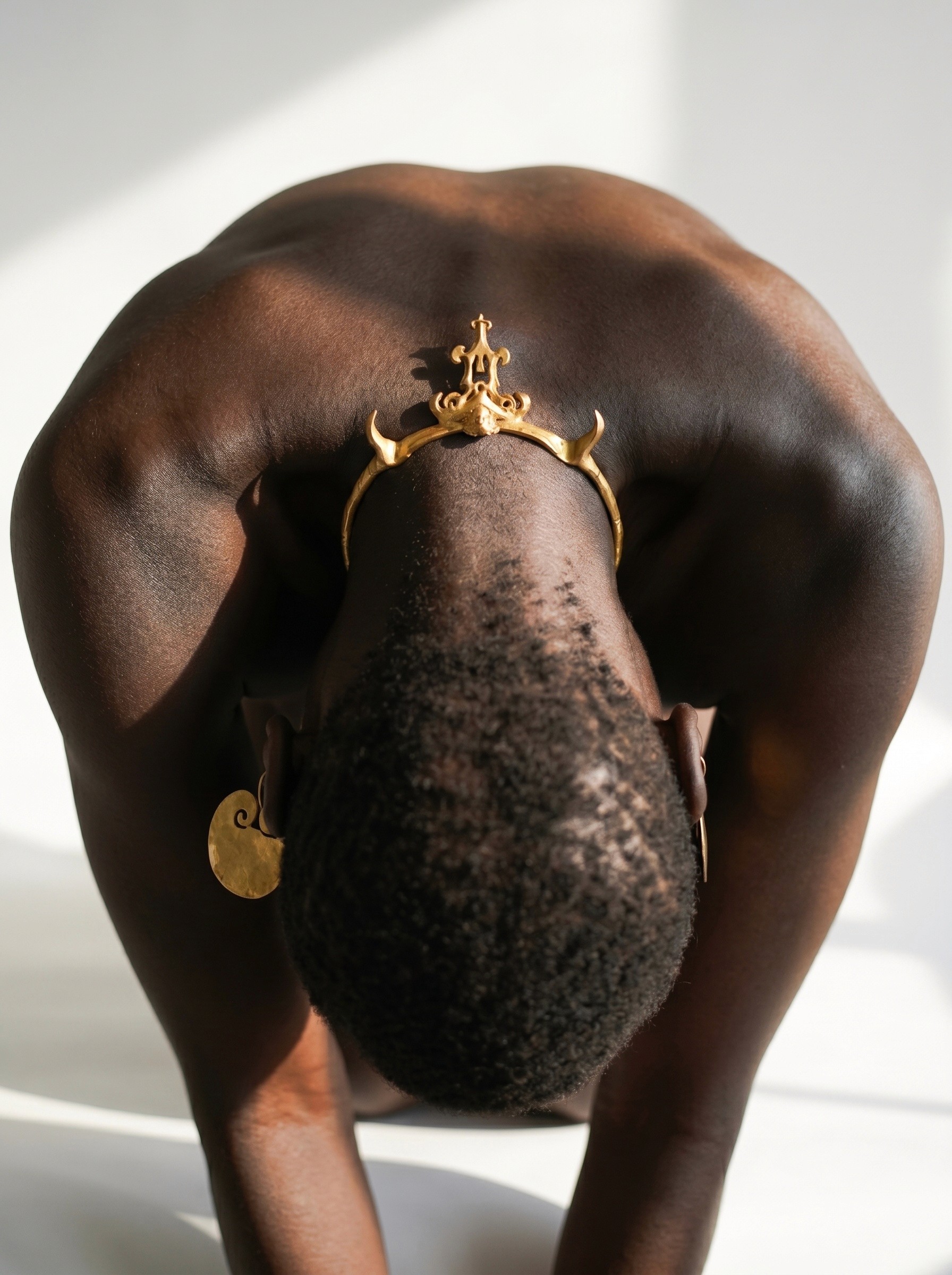
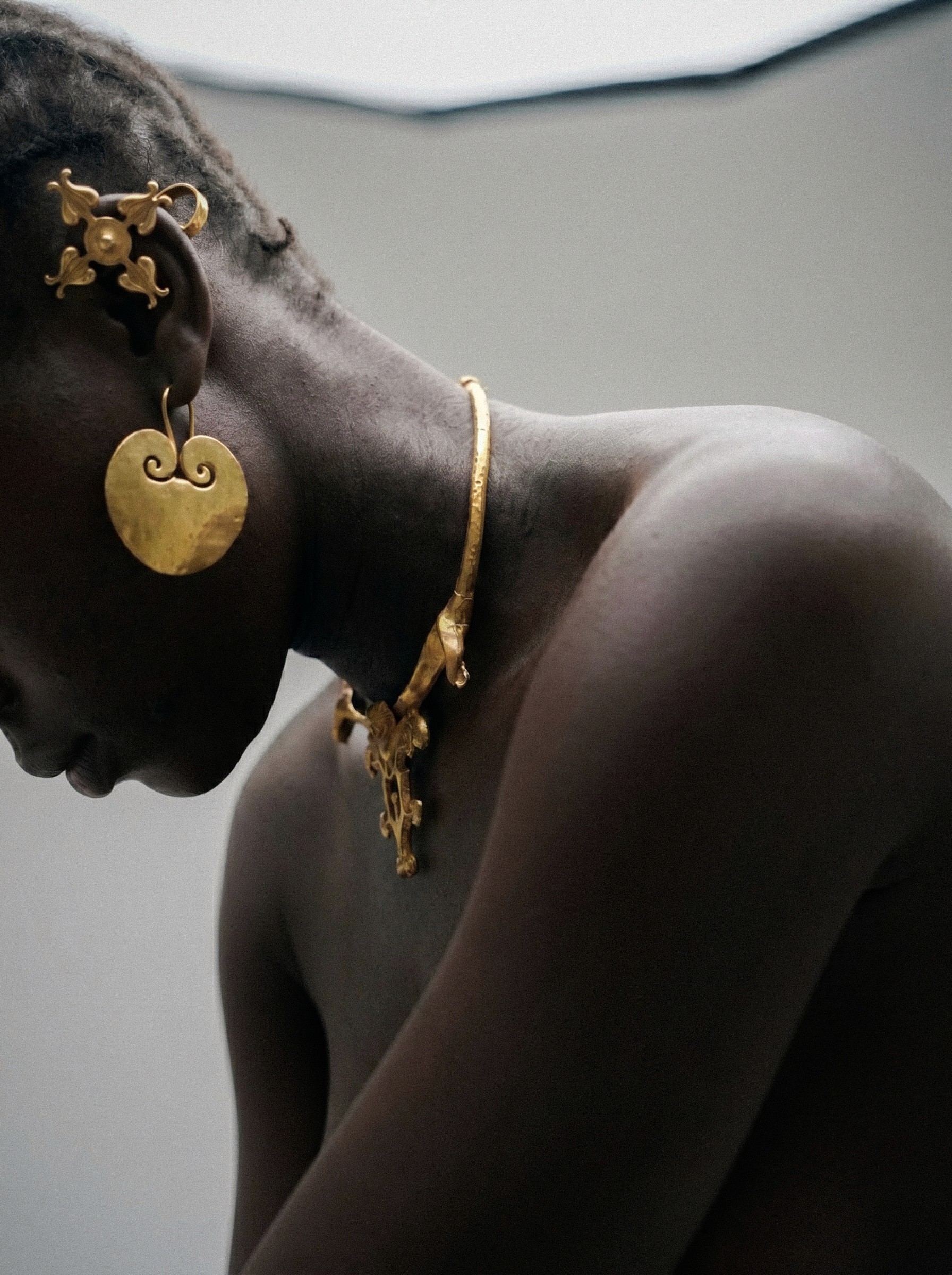
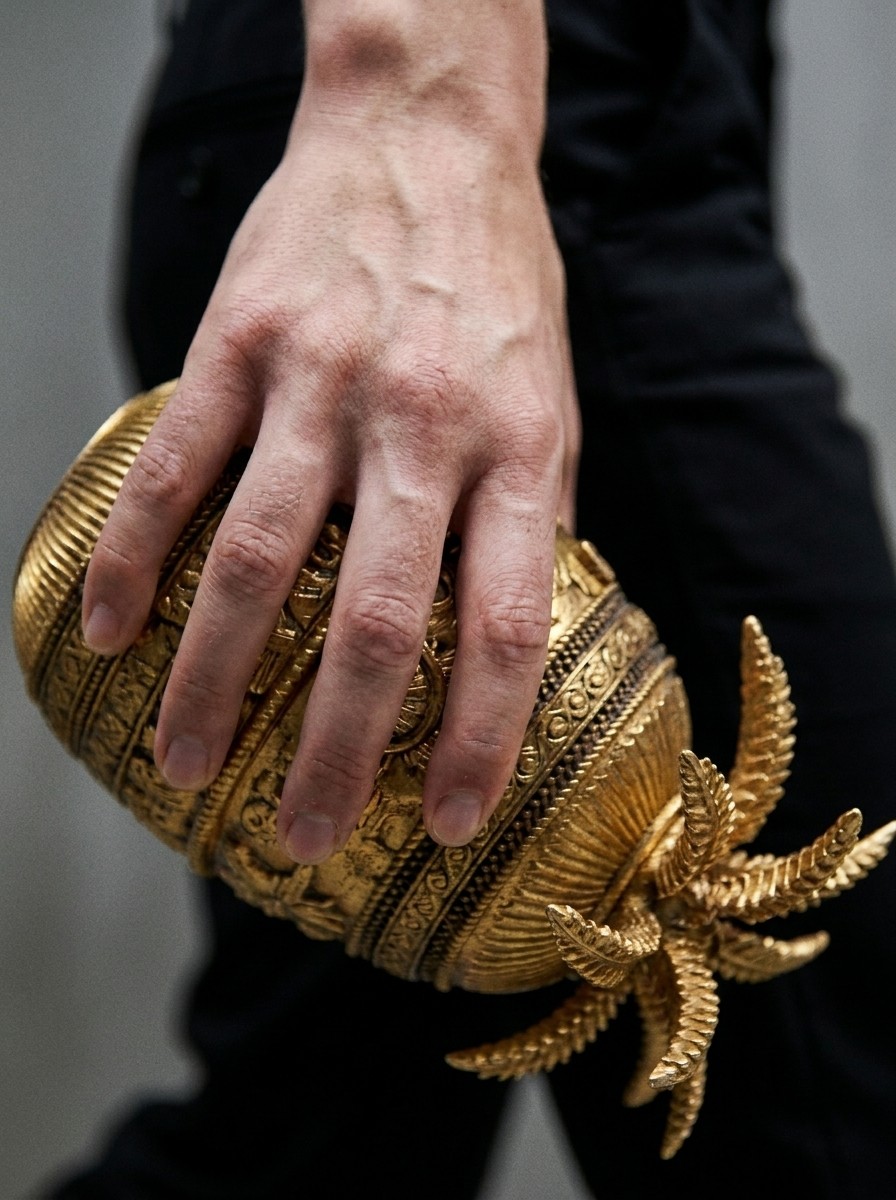
The jewellery she wears: a substantial hand-beaten gold neckpiece from the Miraaki collection, large architectural gold disc earrings, gold cuffs on both wrists, and a thin brass anklet. The neckpiece was the art direction priority across every shot. It needed to catch the overhead sun and return it as warmth rather than glare, which required specific wrist and chest positioning for each take.
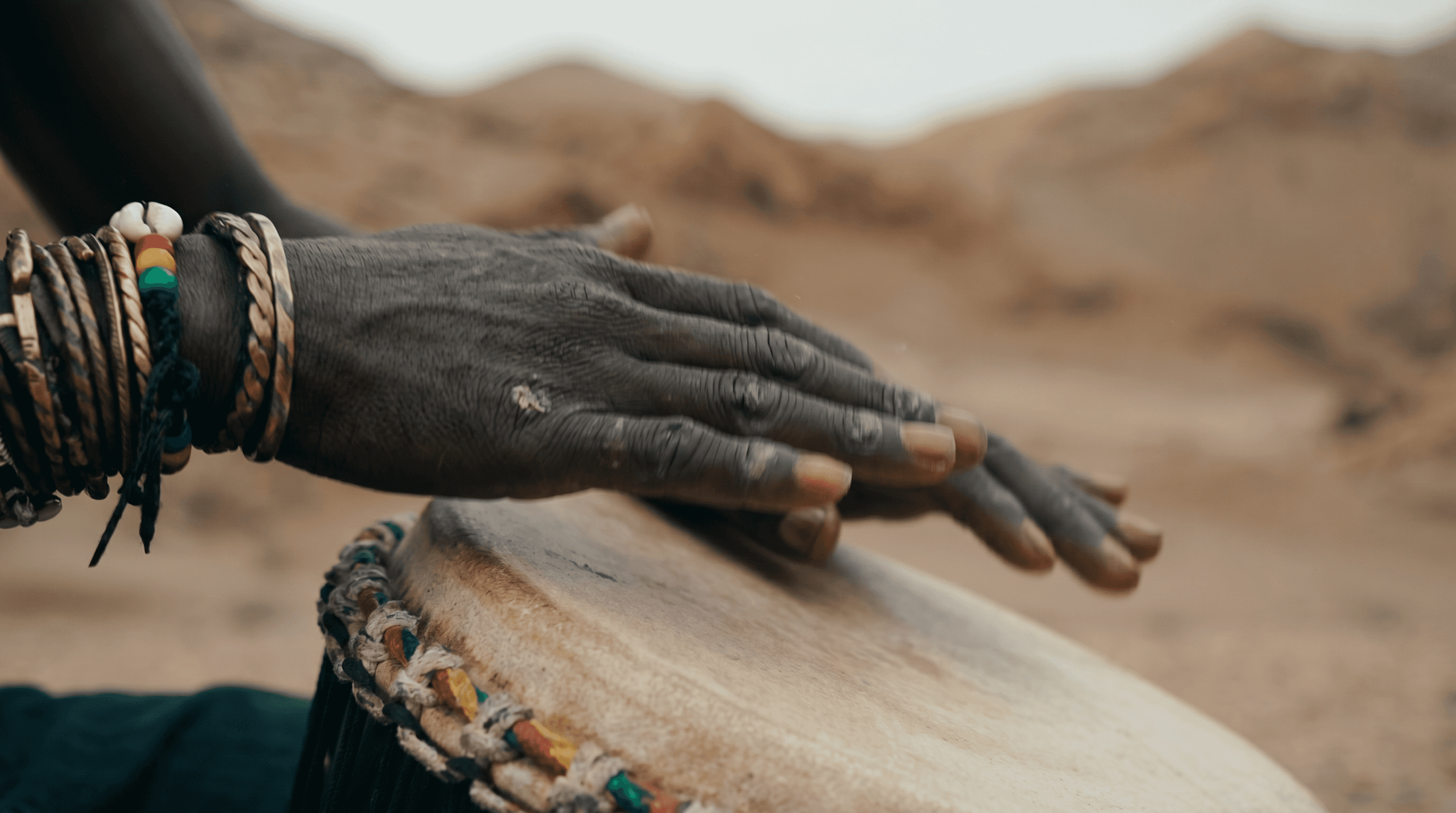
The tribal flock is 8 to 10 performers in naturally-dyed handwoven cotton wraps. No two costumes are identical. Body paint referencing Gondi and Baiga geometric traditions on the arms and collarbones. No shoes. Their brief was simple: move continuously, do not acknowledge the camera, do not acknowledge the character. You are not performing for either of them. You are in your world and she is passing through it.

WARDROBE.
The character's costume went through one revision before the final shoot. An early reference shot was done in a white layered cotton dress. It was wrong. Too clean, too bridal, too much contrast with the earth and the flock's ochre and red tones. The final costume: a muted handwoven open jacket over a rust-toned crop top with wide handwoven trousers in pale earth tones. Bare feet. The gold jewellery then reads as the warmest element in her palette, which means the camera finds it naturally in every frame.
The flock wardrobe decision that mattered most: no matching. Eight people in eight different interpretations of the same material language. They look like they dressed in the dark, in a hurry, in clothes they have worn for years. That's correct.

// 004
THE STORY.

STORYBOARDING.
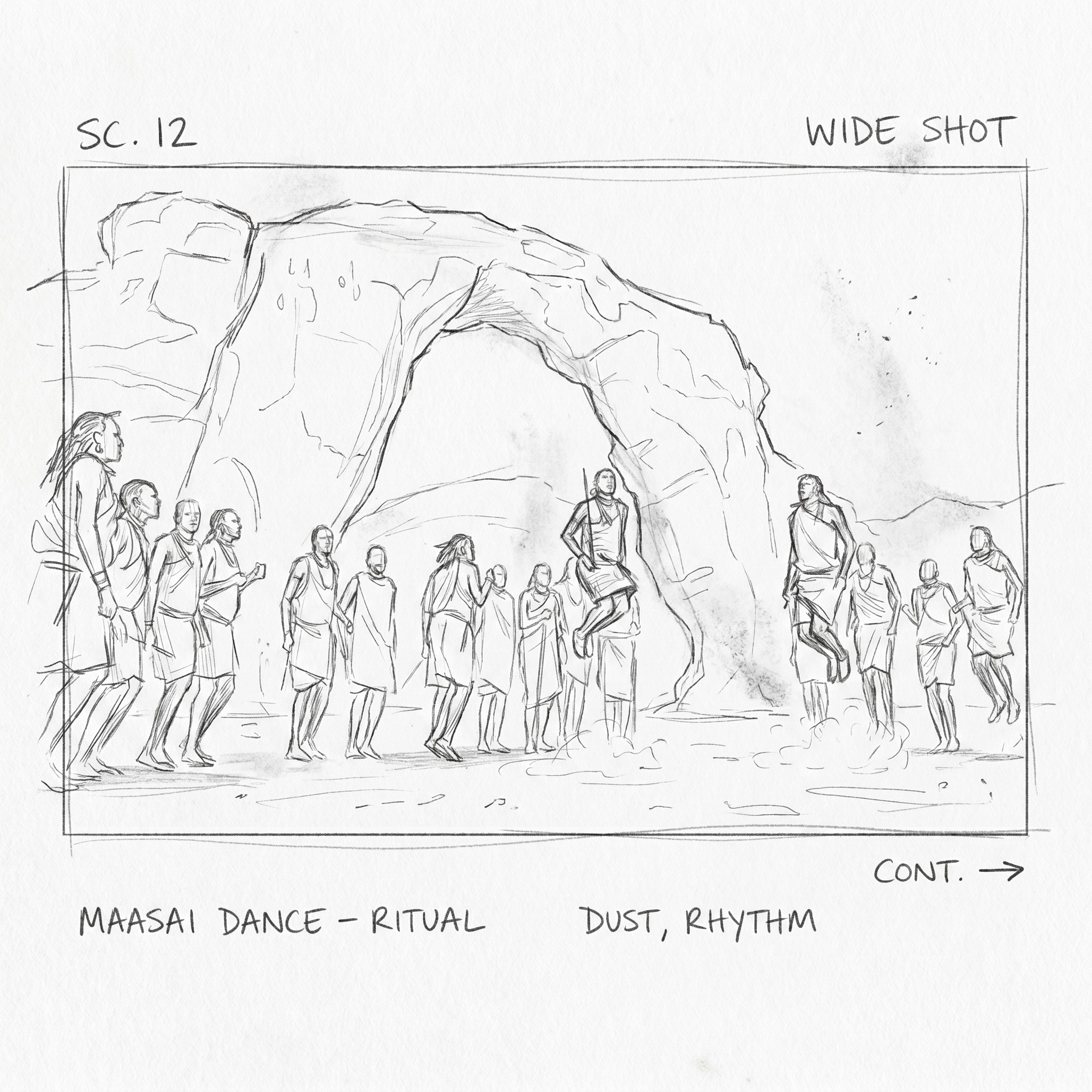
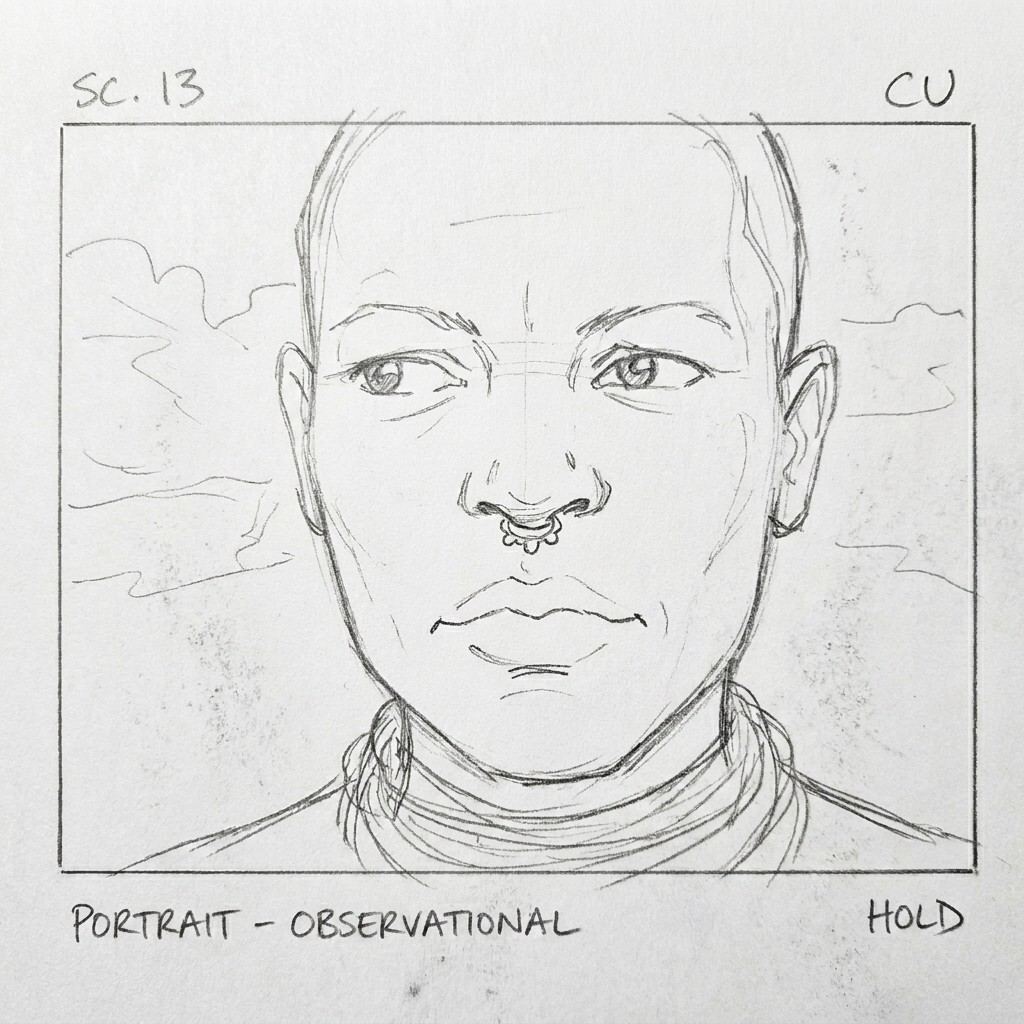
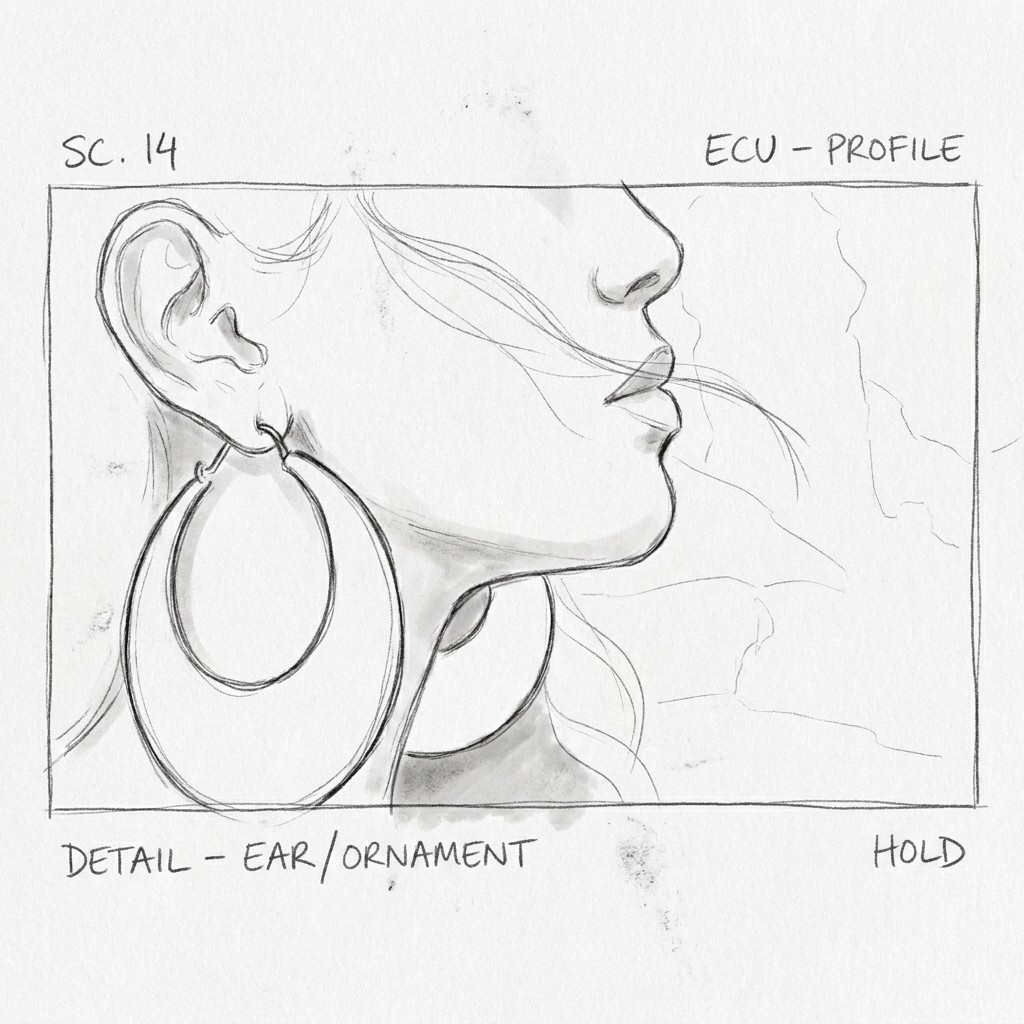
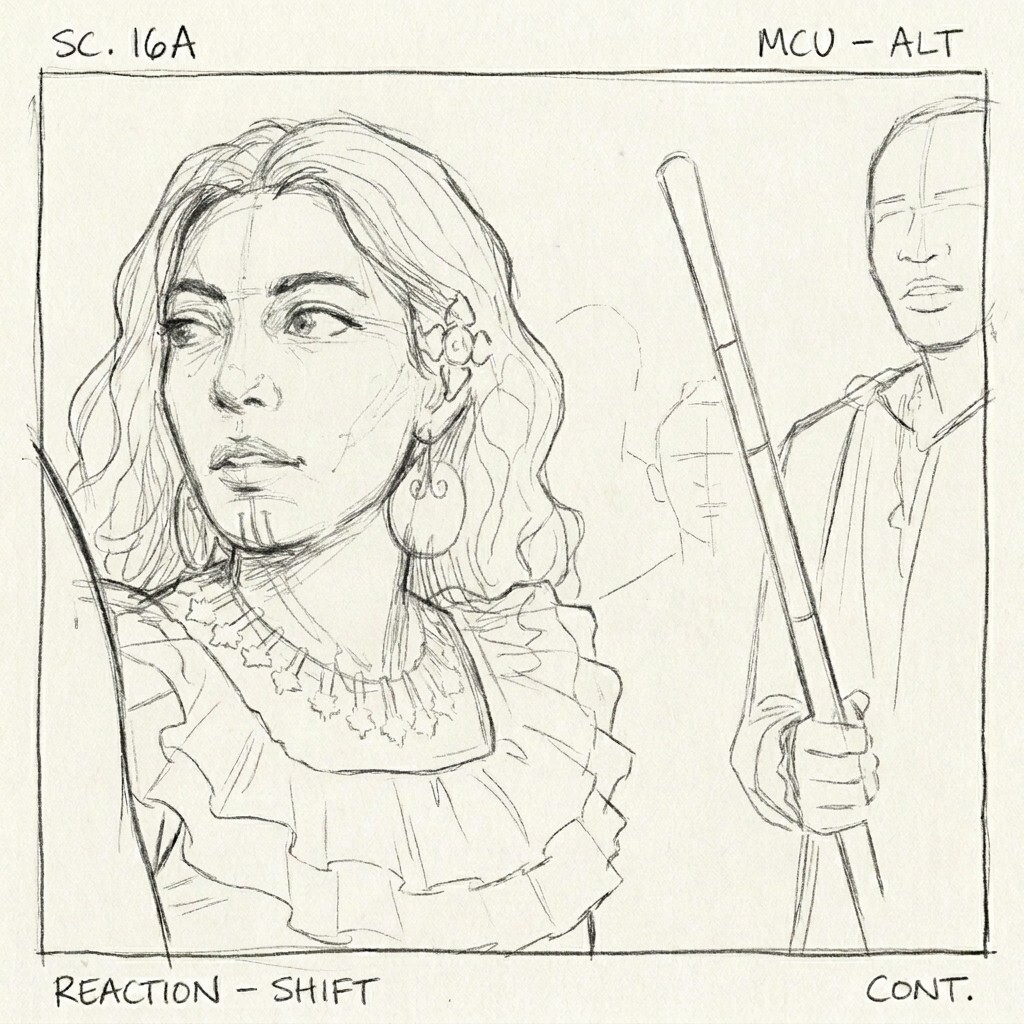
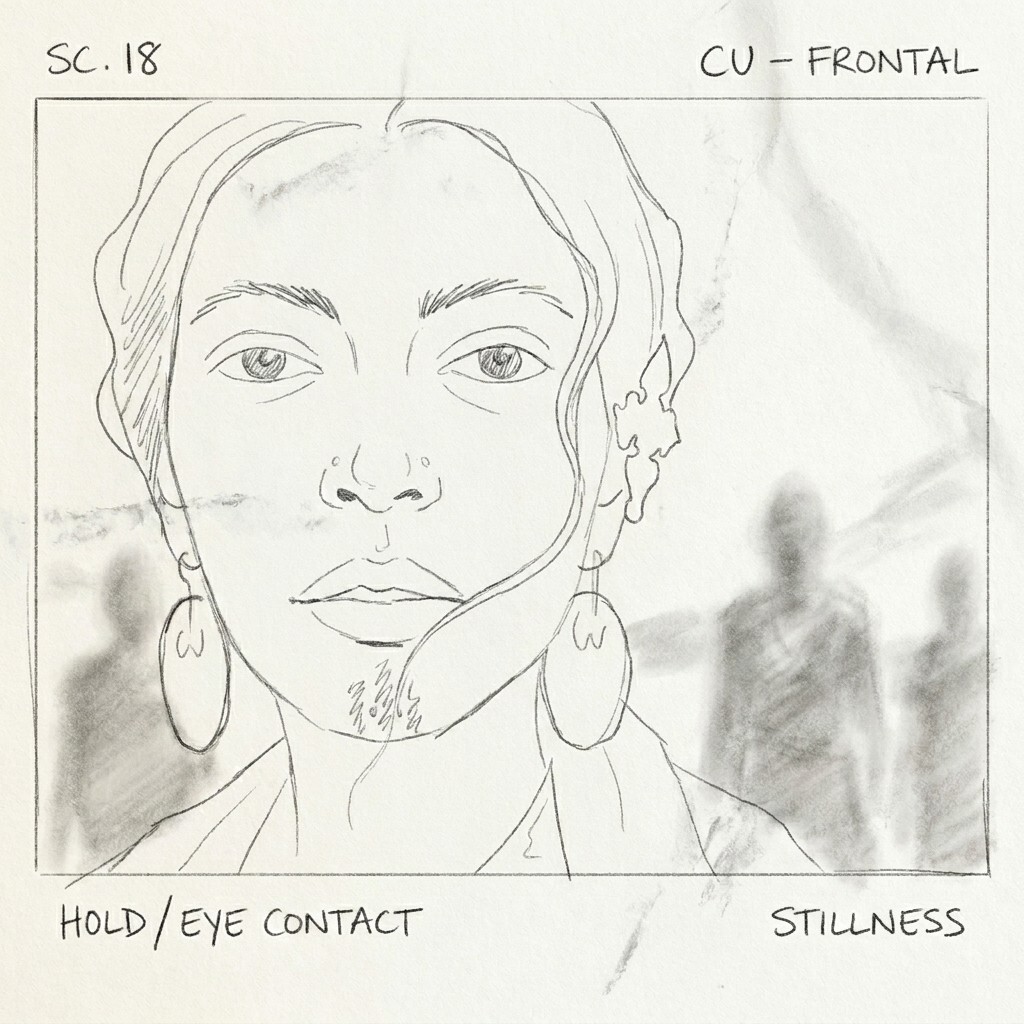
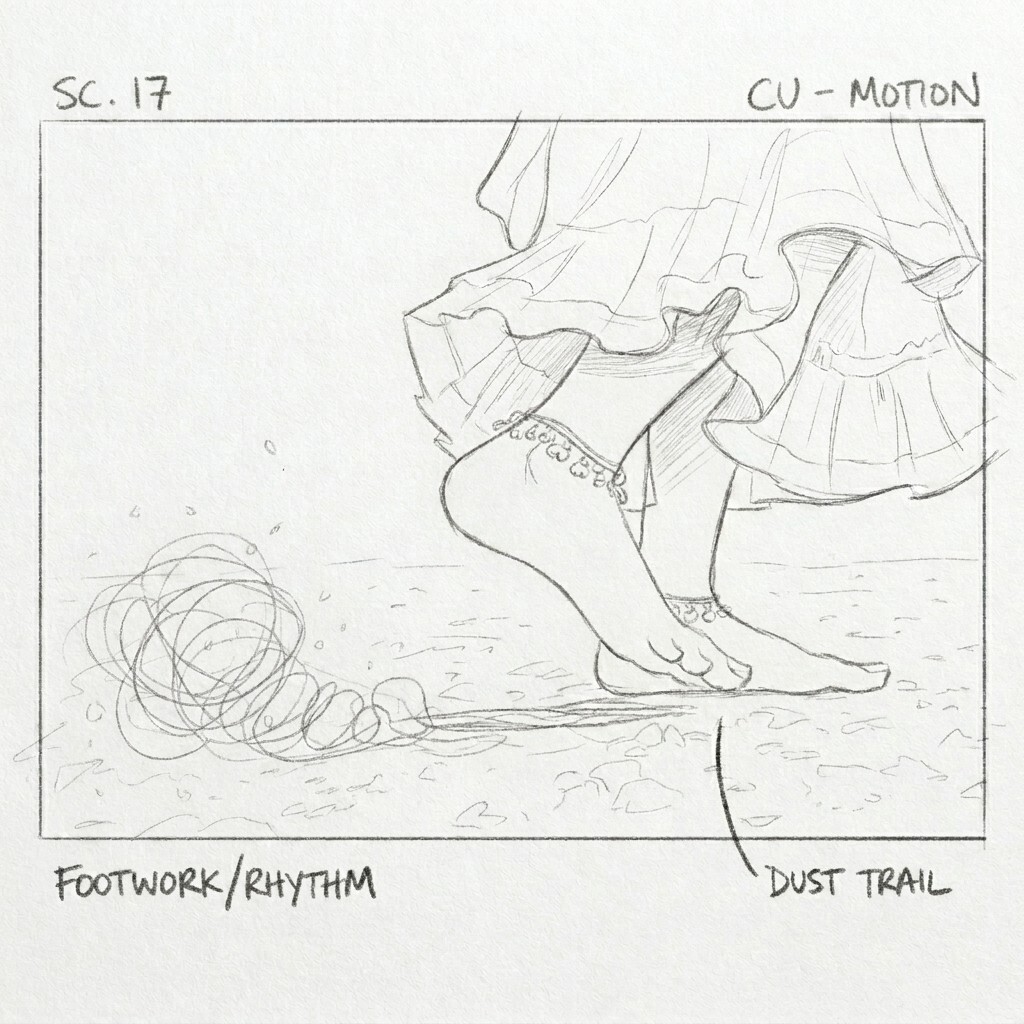
The storyboard was built in four stages. First, the location references were gathered to establish the specific visual register of the landscape. Second, the set design elements were confirmed: linen panel scale and motif, sculpture form, ground treatment. Third, the shot list was built around the five story beats, with each shot categorised by focal length, movement, and purpose. Fourth, AI-generated previsualisation frames were produced using Nano Banana Pro to test composition, light direction, and character-to-flock spatial relationships before committing to the shoot plan.
Every shot in the final film was previewed. The one that deviated most from the previz was the climax rise with the billowing panels, which ended up wider and lower than the original plan because the location gave us a foreground of red earth that was too good to crop out.
// 005
EDITING.

The edit for a 30-second film is mostly about what you refuse to put in.
The first cut was 48 seconds. Too much. We removed the second flock wide shot, shortened the macro sequence by one cut, and tightened the character approach from three shots to two. Nothing was removed because it was bad footage. Everything was removed because the film breathed better without it.
The speed ramps sit at three points: the flock entry, the foreground blur-to-character transition, and the collective peak before the final silence. Each ramp was designed to feel like time choosing to slow down rather than an editorial effect. The difference is in the duration: if the ramp is fast, it reads as a technique. If it takes two seconds to complete, it reads as the world decelerating.
The cut to black before the title card is hard. Not a fade. The film doesn't ease out. It stops. One frame it's there, the next it isn't. That abruptness is the point.
Sound enters the edit at the grade stage, not before. The picture had to work completely silently before I would let the sound design make any argument for a shot's value.
// 006
SOUND DESIGN.

The sound was produced in ElevenLabs and layered in post across eight separate files per scene.
The architecture of the sound design has four layers. The foundation: desert atmospheric, always running, always lowest in the mix. The texture layer: sensory and movement sounds, the body of the design. The punctuation layer: SFX, brief and precise, sitting above texture. The emotional layer: exaggeration sounds, used sparingly, never competing with the punctuation.
Two musical elements thread through the film. A single bowed sarangi playing a slow pentatonic phrase in a Hindustani raga register, entering when the character enters and belonging entirely to her. A tanpura drone on the root note, sustaining from her entrance to the end of the film and surviving every silence intact. The tribal vocal soundscape and the sarangi coexist in the ensemble scenes in direct tension. Neither wins. That tension is the sound design's emotional spine.
One rule that governed every mixing decision: the gold must be the loudest thing in any frame it appears in, even when it makes no sound at all. When in doubt, pull everything else down rather than push the jewellery sounds up.
// 007
TOOLS USED.
Visual development: Nano Banana Pro (Gemini 3 Pro Image Preview) for AI previsualisation frames and missing shot generation. Reference images from the live shoot were fed as character consistency anchors for every generated frame. Sound design: ElevenLabs Sound Effects for all SFX, atmospheric, and exaggeration sound generation. Layered and mixed in post. Campaign copy: Developed across Instagram carousel format, including cover, five image slides, and CTA. SEO-structured with a five-hashtag stack tiered from brand-specific to broad discovery. World-building research: Ten non-cliché tribal material references developed as the conceptual and physical foundation for the campaign's visual language. Displacement principle applied to the calcified water marks concept for the set design. Cinemagraph concepts: Seven looping motion concepts developed for the stone slab set, each designed as a single isolated moving element within an otherwise frozen frame.

GALLERY.